
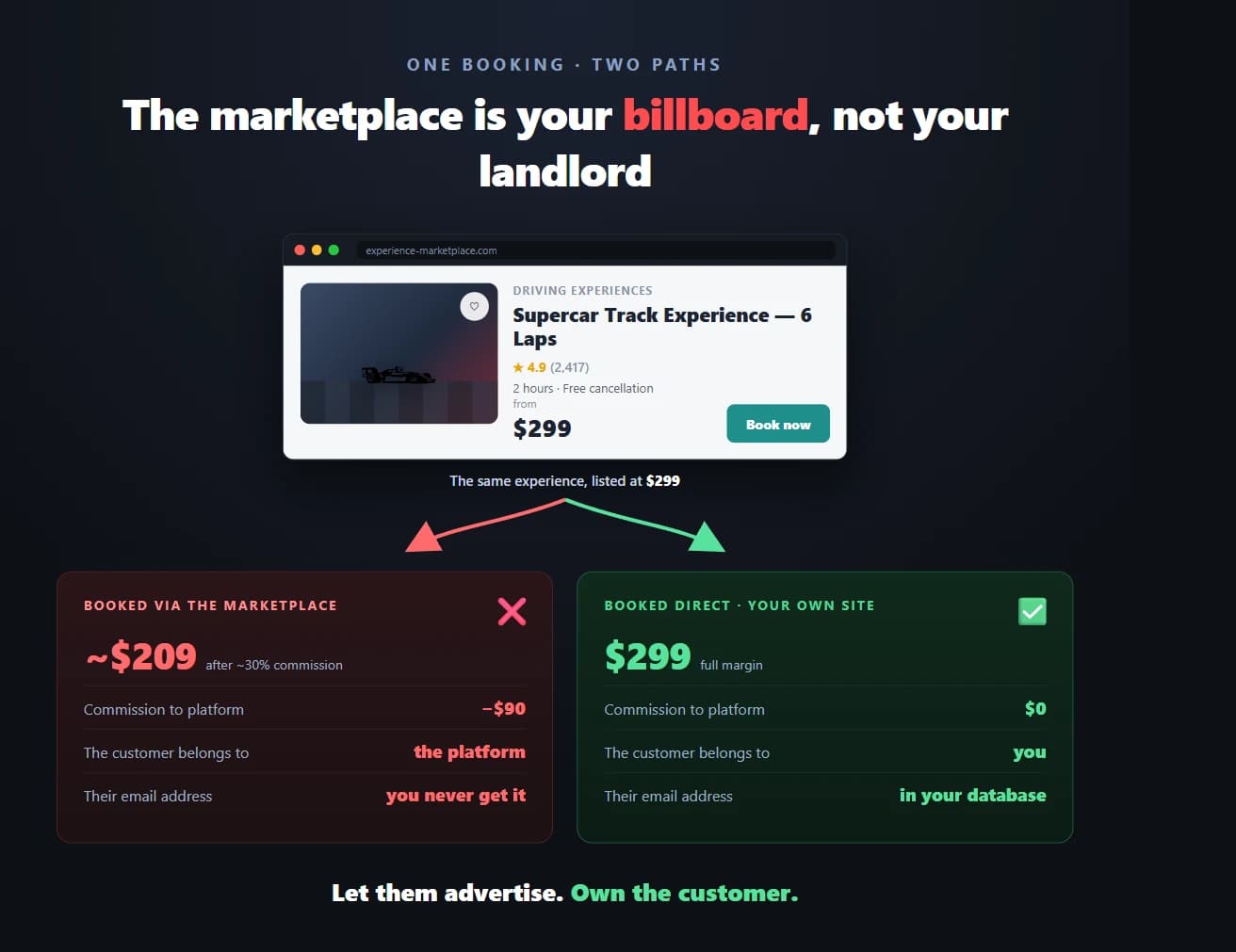
The number they quote, and the one they do not
The commission is steep enough on its own. Viator and GetYourGuide take roughly 20 to 30 percent. Groupon takes 40 to 50. The European gift platforms run around 35. On a $299 experience, a 30 percent cut is $90 gone before you have turned a wheel.
But here is the cost nobody puts in the pitch deck: the platform keeps your customer. When someone books you through one of these marketplaces, you do not get their real email address. Viator masks it. GetYourGuide hands you a relay address that stops working seven days after the visit. The gift platforms keep the buyer entirely, so you may never even learn who paid. You provided the experience, you took on the risk and the cost, and the platform walked away with the one asset that compounds: the relationship.
So you did not buy a customer. You rented an audience, for one visit, at 30 percent. You cannot invite them back. You cannot tell them about a new car, a new track, or a slow Tuesday you need to fill. Every time you want to see them again, you have to rent them again.
Reframe: the marketplace is a billboard
Here is the shift that changes everything. Stop thinking of the marketplace as your store. Think of it as a billboard. Being listed is genuinely useful. It puts you in front of people who have never heard of you, the person who searches “driving experience near me” with no brand in mind. That discovery has real value. The mistake is letting the discovery and the transaction happen in the same place, because that is where the platform takes its cut and keeps its grip on your customer.
The move is to use the marketplace for what it is good at, getting seen, and then pull the booking back to your own site, where you keep the full margin and the customer lands in your own database. And most people will come to you if you let them. Someone who spots you on a marketplace and actually wants to come does the obvious thing: they pull out their phone and search your name. If your own site is easy to find and easy to book, they book direct. The platform just paid to advertise you for free.
How to win the direct booking without breaking your contract
This is the part to get right, because the naive version can put you in breach. You may have heard the advice “list higher on the marketplace and stay cheaper on your own site.” Be careful. In the US, Viator’s supplier agreement includes a most-favored-nation clause, and GetYourGuide runs a price-match guarantee. Openly undercutting them on your own website can violate the terms you signed. You do not need to. You can make the direct booking clearly better without touching the listed price:
- Member price. A free signup on your site unlocks a better rate. It is a different product tier, so it does not breach parity. The big platforms use this exact trick against you.
- Bundle. Add something the marketplace listing does not carry: an onboard video, a data debrief, a car upgrade, priority scheduling. The direct offer is simply worth more for the money.
- Direct-only perk. Same price, but direct bookers get an extra the platform buyers do not.
Same result. Direct wins, and you stay fully inside your agreements. One useful exception: Groupon’s merchant terms have no parity clause, so it can run purely as an acquisition tool, a deep-discount intro deal to fill soft capacity, while your real pricing holds everywhere else. Just remember its cut is the steepest, so it only makes sense as a loss leader, never as a revenue channel.
If you operate in Europe, you have even more room
Operators in Germany and the wider EU should know the law has moved in their favor. The German Federal Court struck down best-price clauses in 2021, and in September 2024 the EU Court of Justice ruled platform price-parity clauses anticompetitive in the Booking.com case. In practice that means European operators generally can offer a lower price on their own site than on the marketplace. Worth a two-minute check of your specific contract, but the direction of the law is clear.
The one thing no contract will give back: the customer
Even done perfectly, a marketplace booking arrives with no usable contact details. The only place to fix that is at the experience itself. When the customer is standing in front of you, that is your single best chance to make them yours instead of the platform’s:
- A waiver with an email opt-in.
- Deliver their lap times or their video to an email they give you.
- A “next session” offer at check-in.
Capture them on-site, and the marketplace visitor becomes a customer you own, ready for the next invitation.
Why this comes down to your own system
All of this only works if you actually have somewhere to put the customer. A direct booking is only valuable if your own site captures the email, remembers the visit, and lets you bring them back. That is the whole point of owning your booking platform instead of living on someone else’s. The marketplaces are designed to prevent exactly that. Your own system is where the margin and the relationship finally belong to you.
Let the marketplaces be your billboard. Capture every customer on site. And make sure the next booking always comes home.